Sheep house - Maison du Mouton
Sheep house - Maison du Mouton
Address
Rue du Mouton
26100 ROMANS-SUR-ISÈRE
Contact
Languages spoken
- French
Rue du Mouton
26100 ROMANS-SUR-ISÈRE
New!
Come and discover the Maison du Mouton, one of the oldest residences in Romans, now a Maison du patrimoine!
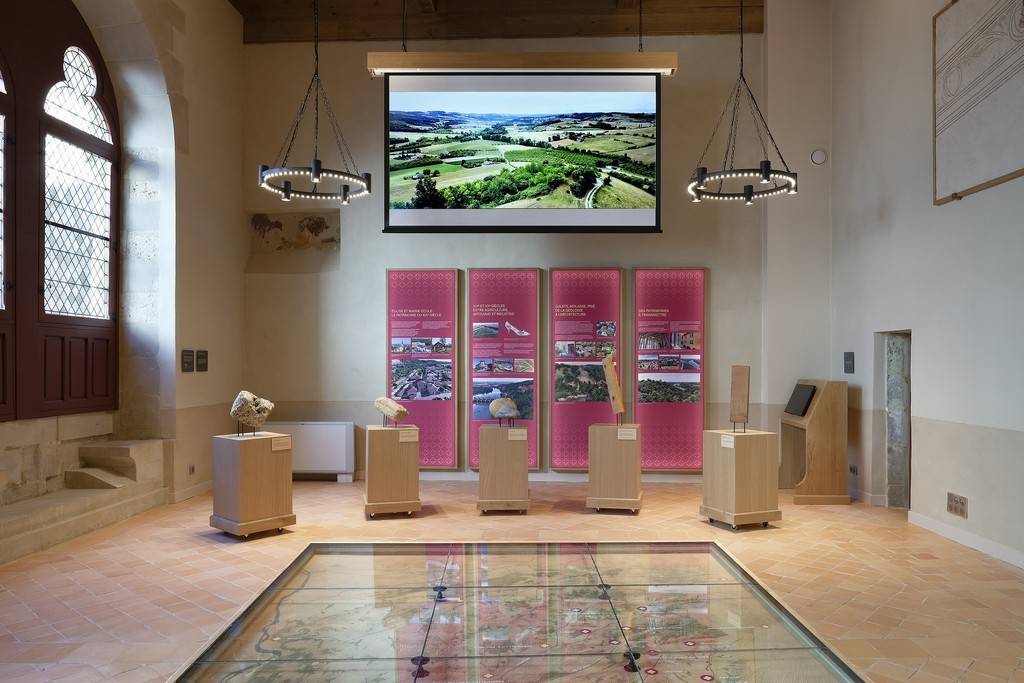
A free space open to all, inviting you to discover the heritage of the Isère Valley and the Drôme des Collines.
History
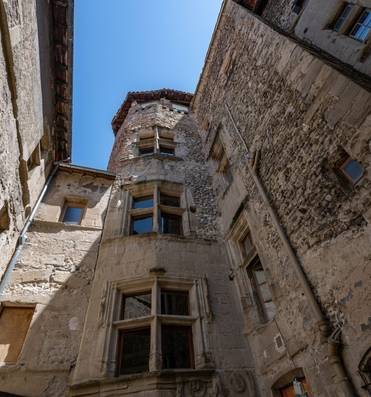
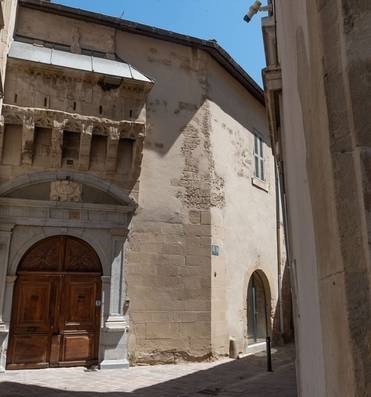
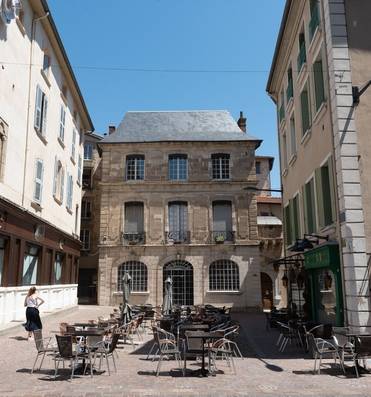
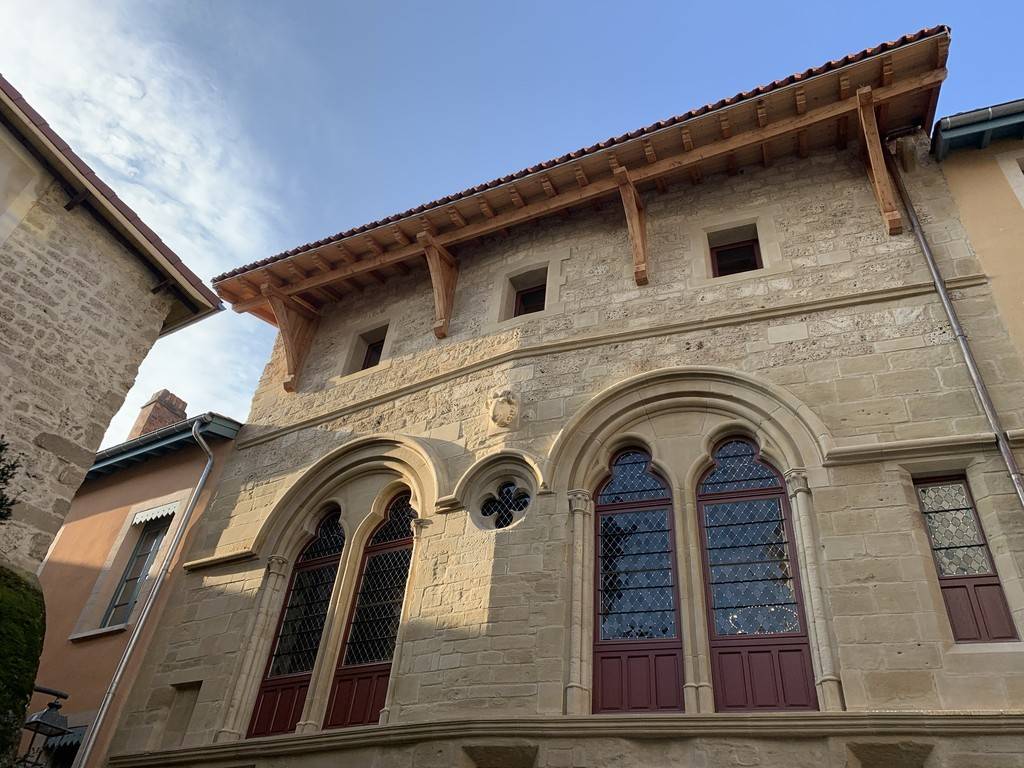
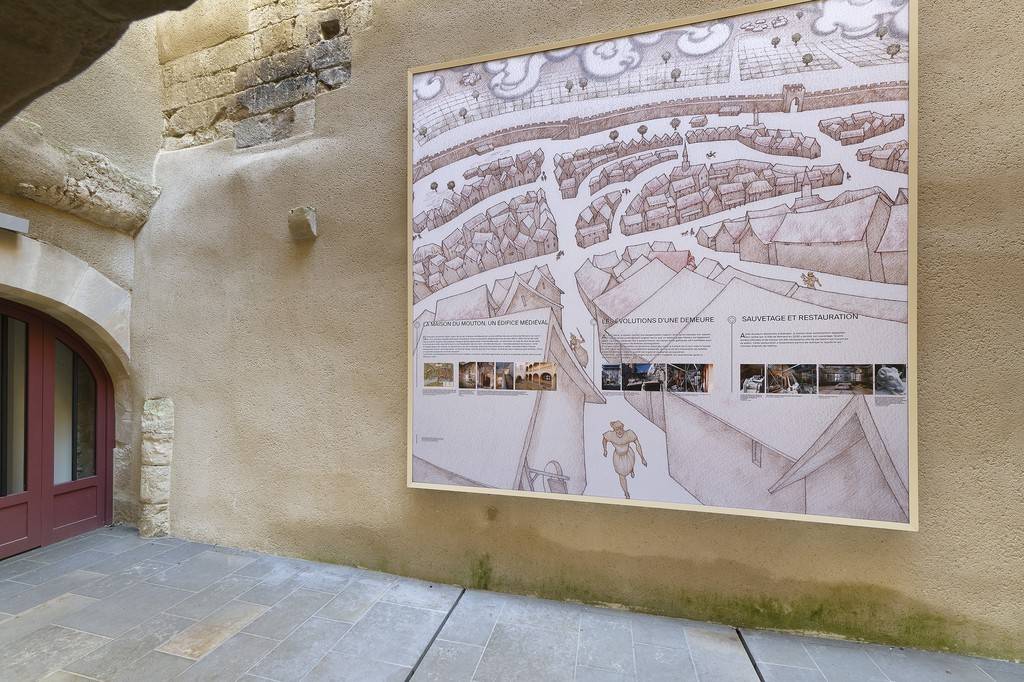
Located in the first urban core of the city, the Maison du Mouton is one of the oldest buildings in Romans. On the street and on the courtyard, its two Gothic facades are indeed dated from the end of the 13th or the beginning of the 14th century. Ashlar stones, painted decorations, extent of the spaces indicate that it belonged to
a well-off family. The woolen cloth trade then made the fortune of the city: perhaps one should see in it the explanation of its name.
A sheep’s head has adorned the facade since its origin. Very deteriorated, it was returned during major restoration works carried out between 2020 and 2024.
The stone used probably comes from the molasses quarries located in Châteauneuf-sur-Isère. These quarries, about fifteen kilometers apart, were exploited from antiquity to the 19th century.
Once extracted, the molasse, fine stoneware and easy to cut, circulated by river, both towards Romans and towards Valencia. For the framework and intermediate floors, softwood was mainly used.
Beautiful medieval house abandoned during the 20th century, the Maison du Mouton was acquired by the City of Romans in 2020.
Open to the public after restoration since 2025, it now houses one of the two sites of the Heritage House of the Land of Art and History of Valence Romans Agglo. The
public there discovers the history and architectural heritage of Romans and the Drôme des collines. In Valence, the visitor can continue his visit at the Maison des Têtes, second site dedicated to local heritage.
Originally, the ground floor had a commercial or artisanal vocation. The large bays being closed by wooden shutters, the light came from square-shaped light cannons, drilled into the masonry and located high up.
The French oak ceiling was restored during the restoration work.
It is through this space that the public enters the Heritage House today.
An educational workshop also welcomes teachers and their classes.
The rear facade of the house is remarkably preserved in its 14th century state. Under the modern staircase, the original straight staircase has been partially preserved. It
gave access to the floors from the outside, from the courtyard. The frame of a well is also visible in the masonry.
At the back of the house, a building was erected in the 15th or 16th century. This outbuilding could have served as an annex for residential and service uses.
Upstairs, a majestic room nearly six meters high corresponds to the aula of the medieval house. Both a reception room and a space for private use, it was
the heart of the residence. Heated by an imposing chimney now disappeared, the hall was lit by two tall gothic bays, geminate and trilobed.
In front of them, there are seat cushions. These benches arranged in the window recess served as seats.
The second floor was able to house the housing of the servants and storage spaces.
The offices of the Heritage-Country service for art and history are now located there.
Archaeological excavations have unearthed numerous traces of painted decorations, which reveal a pronounced medieval taste for color and geometric patterns.
In the aula, a decoration dated from the 14th century, composed of yellow squares on a red background and white borders, was discovered during the work. It has been preserved in situ.
In this same room, a decor from the Hôtel de Loulle presents a frieze of coats of arms decorated with plant motifs, in shades of black, red, yellow and blue. The quality of these paintings indicates that high-ranking families occupied the houses in the neighborhood.
On the second floor, a simpler decoration, imitating an apparatus of stones, was also discovered. It covered the entire space, in a common approach to many buildings of the same period.
From 02/01 to 31/12 on Tuesday, Wednesday, Thursday and Friday between 1 pm and 6 pm. Weekends between 10 am and 1 pm and between 2 pm and 6 pm.
Free entry.
Cultural heritage
Valence
Cultural heritage
Romans-sur-Isère