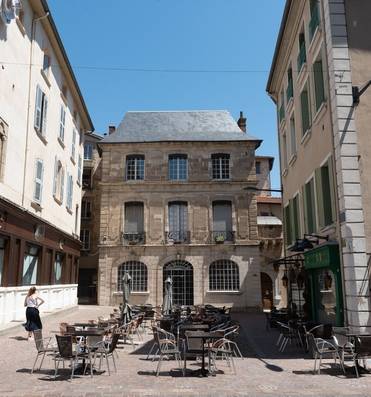
Collegiate church of Saint Barnard


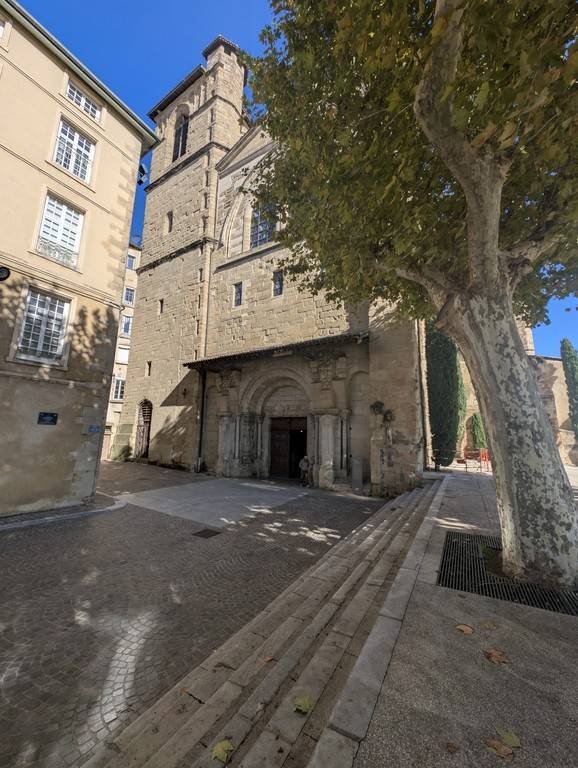
Collegiate church of Saint Barnard
Address
Quai Ulysse Chevalier
26100 ROMANS-SUR-ISÈRE
Contact
Languages spoken
- French
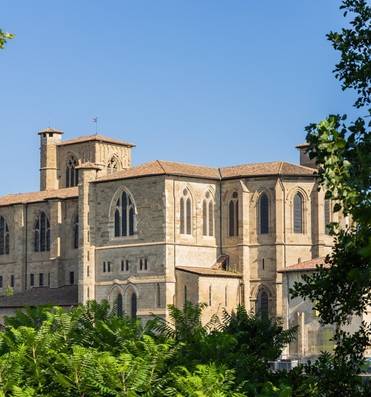
This monastery, founded in 838 by Barnard, Archbishop of Vienne, is the origin of the city of Romans. A blend of Romanesque and Gothic styles, it houses nine embroidered tapestries depicting the Passion of Christ (on display during the season and as part of a guided tour).
Converted into a collegiate church around 935, the church was destroyed and rebuilt several times during the Middle Ages. Its designation as a Historic Monument in 1840 attests to its importance in terms of history and art history.
West Facade
The west entrance of the church is adorned with Romanesque sculptures of southern inspiration depicting the apostles. To the right of the entrance, one can recognize Saint John with
a book at his feet. To the left, the word “PETRUS” can be made out on a scroll: this is Saint Peter. The other sculptures may
depict Saint Paul and Saint James the Greater. The four figures are surrounded by lions, small columns, and capitals with rich plant motifs evoking antiquity.
Damaged during the French Revolution, the ensemble was also completely redesigned at an undetermined date.
Nave
The nave is composed of elements from several periods. Dating from the 11th century, the lower sections are the oldest parts of the building. The nave was raised in the 13th
century, adorned with a triforium (upper gallery) and covered by a ribbed vault.
The triforium and vaults, destroyed in 1567 during the Wars of Religion, were rebuilt identically at the end of the following century.
On the north side, one can see Romanesque historiated capitals depicting biblical scenes (the Visitation, the Last Judgment) and mythical creatures.
On both sides of the nave, chapels were established and decorated between the 15th and 19th centuries.
The large sacristy showcases superb 18th-century walnut woodwork and numerous examples of sacred art.
On the organ loft, built in 1720, stands an organ crafted by the organ builder Chambry* and installed in 1843. This is likely the fourth or fifth organ to have been installed in the building.
Above the organ, stained-glass windows installed in 2000—designed by artist Georg Ettl and crafted by the Thomas workshops—offer a modern interpretation of the Book of Revelation.
*An organ builder is a craftsman specializing in the construction of organs
Choir and Transept
The choir and transept were constructed beginning in 1238 in the Gothic style, following a decision by Jean de Bernin, Archbishop of Vienne, who was known for his role as a builder. The
exceptional decoration found today in the choir dates from the 1330s to the 1350s. It was indeed at this time that the Dauphin Humbert II, also a canon of Saint-Barnard, ceded the Dauphiné to the French crown during a ceremony held in Romans in 1349. In this richly decorated setting, one can indeed recognize fleurs-de-lis and crowned figures, as well as angels on a crenellated parapet and plant and geometric motifs.
In both arms of the transept, numerous traces of paint originate from decorative elements created successively from the 13th to the 19th century.
Temporary exhibitions and concerts are held several times a year in this building.
Guided tours are available for groups and individuals.
From 01/01 to 30/06 from Monday to Friday between 9 am and 6.30 pm. Weekends between 9 am and 6 pm.
Self-guided tour of the nave.
Free access. Paying guided tours.