Eglise Notre Dame de Lourdes
Eglise Notre Dame de Lourdes
Address
7 Rue Solférino
26100 ROMANS-SUR-ISÈRE
Contact
Languages spoken
- French
7 Rue Solférino
26100 ROMANS-SUR-ISÈRE
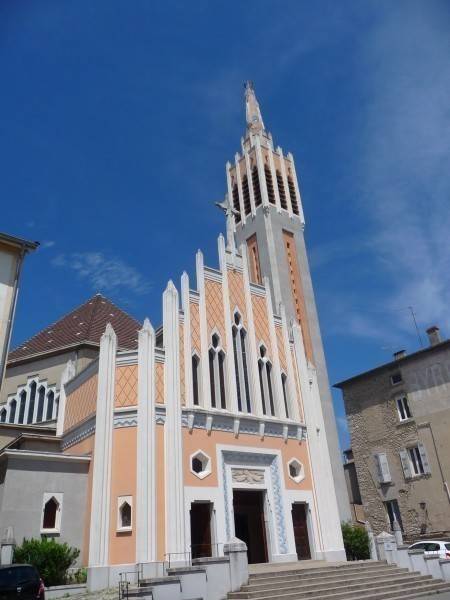
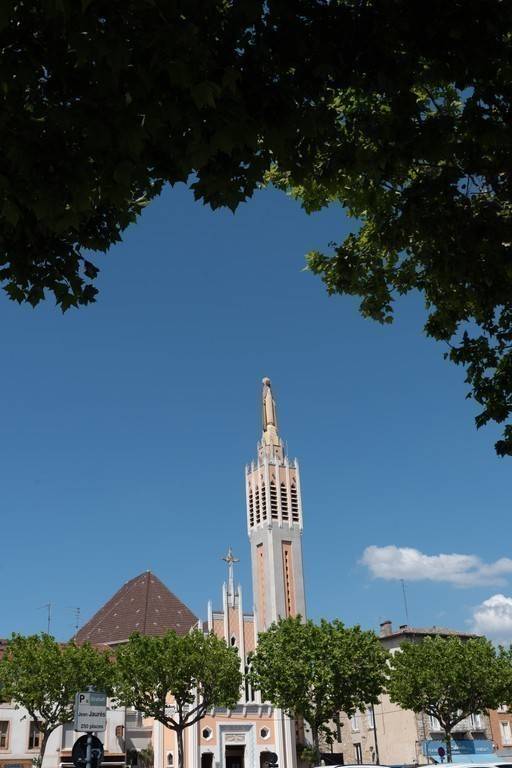
Consecrated in 1938 and completed in 1940, it has been protected as a Historic Monument since 2024 and serves the new station district.
The monument is labelled as 'heritage of the 20th century'.
It has been classified as a Historical Monument since 2026
As the area around the railway station expanded, the Diocese of Valence undertook the construction of a new place of worship on a plot adjoining Romans’ new central square.
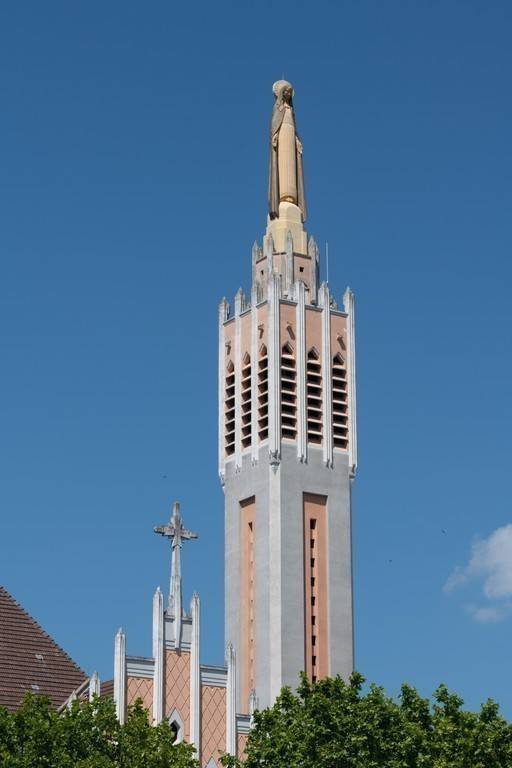
The project was entrusted to architects François Bérenger and Dom Bellot, who took their inspiration from the modern Gothic style. Built in reinforced concrete, the church
also reflects the influence of the Art Deco movement.
The façade is punctuated by Gothic openings and gables. The bell tower rises to a height of 45 m. The statue of the Virgin Mary, nearly 7 m high, and the other statues are by Georges Serraz. The three interior bays combine to form a single cupola. The altar is by the sculptor Toros.
The Stations of the Cross were painted by Jac Martin-Ferrières. Born in 1893, he was initially influenced by the pointillist movement before developing his own distinctive style.
Both a painter and a chemist, he revived the ancient technique of encaustic painting, in which pigments are mixed with beeswax.
This method allowed him to achieve richer contrasts and greater depth of colour. He approached the theme of the Stations of the Cross as a continuous visual narrative,
unfolding across the walls of the church and extending into its domes.
The stained-glass windows were entrusted to two master glassmakers: Louis-Ferdinand Balmet of Grenoble, who worked on the nave and choir, and Georges Thomas of Valence, responsible for the entrance. From 1941 to 1949, the glassmakers, painter and sculptor collaborated closely to create a harmonious ensemble, where light enhances and unifies the various artworks within the church. The chosen iconography is classical in tone: each window depicts a saint, several of whom are dedicated to Our Lady.
The dominant use of blue may also be seen as a tribute to Mary, traditionally associated with this colour.
The choir furnishings were commissioned in 1984 from Toros, a sculptor from Romans of Armenian origin. Made from sheets of brass, these minimalist pieces depict children —
one bearing a lyre (lectern), others reaching their arms skyward (altar). At the centre of the altar, a crouching mother sheltering her child completes the composition.
All year round daily.
Free access.